
If your Central Florida power bill climbs every summer, your attic insulation may be part of the reason.
The good news?
Replacing your attic insulation can help combat those rising costs. Keep reading to learn more about attic insulation so you can know what actually drives the quote.
For 2026, Florida market data puts common installed attic insulation anywhere from roughly $1.00 to $6.50 per square foot, depending heavily on the material and whether you are topping up an attic floor or insulating the roof deck. EPA modeling also shows that air sealing plus insulation can reduce heating and cooling costs in Climate Zone 2 by about 9% on average.
Below, we’ll break down real-world price ranges, costs by attic size, R-value considerations, possible energy savings, simple payback, and the sneaky factors that can push a quote higher. No contractor math degree required.
The short version? The cheapest insulation is not automatically the best value, and the most expensive option is not automatically the smartest upgrade.
How Much Does It Cost to Insulate an Attic in Florida?
For a straightforward Central Florida attic insulation project, a useful planning range is about $1 to $7 per square foot installed. Blown-in fiberglass, cellulose, and fiberglass batts generally fall on the lower end, while spray foam costs substantially more because both the material and installation process are different.
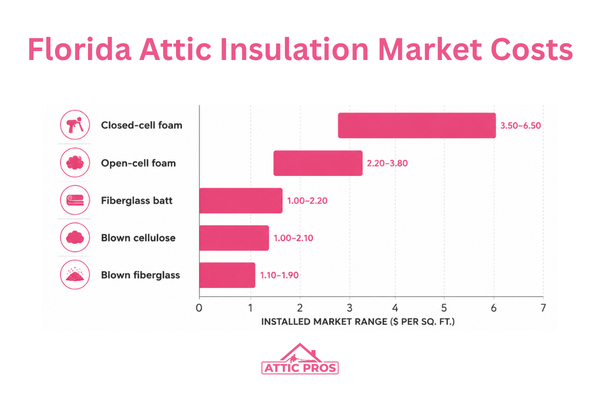
One 2026 Florida pricing source reports blown-in fiberglass at $1.10–$1.90 per square foot, cellulose at $1.30–$2.10, batts at $1.00–$2.20, open-cell spray foam at $2.20–$3.80, and closed-cell spray foam at $3.50–$6.50.
We recommend getting a quote specific to your home because attic size, existing insulation, access, contamination, ductwork, and the target R-value can all change the scope.
Attic Insulation Cost by Attic Size
Square footage is one of the cleanest ways to estimate a starting budget. The table below shows estimated costs for three common attic sizes to illustrate how square footage can affect the overall budget.
| Material | 1,000 sq. ft. | 1,500 sq. ft. | 2,000 sq. ft. |
|---|---|---|---|
| Blown fiberglass | $1,100–$1,900 | $1,650–$2,850 | $2,200–$3,800 |
| Blown cellulose | $1,300–$2,100 | $1,950–$3,150 | $2,600–$4,200 |
| Fiberglass batt | $1,000–$2,200 | $1,500–$3,300 | $2,000–$4,400 |
| Open-cell foam | $2,200–$3,800 | $3,300–$5,700 | $4,400–$7,600 |
| Closed-cell foam | $3,500–$6,500 | $5,250–$9,750 | $7,000–$13,000 |
Important: These estimates cover insulation materials and installation only. If the attic needs insulation removal, sanitizing, extensive air sealing, duct repairs, or difficult-access labor, the final project cost can rise quickly.
Removal and disposal may add roughly $1–$2 per square foot, depending on the condition of the existing insulation and the amount of cleanup required. ENERGY STAR also recommends correcting wet, moldy, or pest-contaminated conditions before insulating.
Two 1,500-square-foot attics can have very different price tags if one is clean and accessible while the other requires extensive cleanup or has difficult access.
What R-Value Should a Central Florida Attic Have?
R-value measures how well insulation resists heat flow; the higher the number, the greater the resistance. The U.S. Department of Energy’s 2021 IECC reference lists R-49 for uninsulated ceilings in Climate Zone 2, while R-30 or R-38 may be appropriate for some existing-home projects depending on the current insulation, assembly, and project goals.
That difference matters because an existing home upgrade is not always the same situation as a new-code prescriptive assembly. A professional should look at what is already installed, how the attic is built, and the home’s actual performance before recommending a target. Review DOE’s climate-zone R-value guidance.
| Option | Typical application | Cost tendency | What to know |
|---|---|---|---|
| R-30 | Existing attic upgrade / project-specific | Lower | May be appropriate depending on existing insulation and scope. |
| R-38 | Common Central FL upgrade target | Moderate | Frequently used for loose-fill fiberglass attic work. |
| R-49 | Higher thermal resistance / code-reference target | Higher | Requires more material or a higher-R assembly than lower targets. |
The takeaway: ask every contractor to specify the material, target R-value, installed depth, and square footage included in the quote.
How Much Can Attic Insulation Save on Energy Bills?
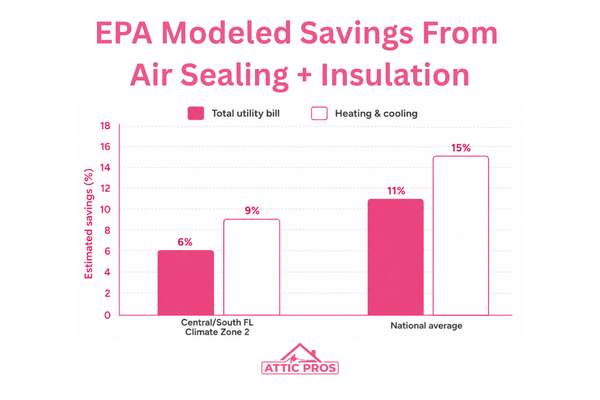
EPA’s ENERGY STAR methodology estimates that air sealing and insulation improvements in Climate Zone 2 can save about 6% on total annual utility costs and 9% on heating and cooling costs for a typical existing home.
That is lower than the 11% total-bill and 15% heating-and-cooling national averages, which makes sense: Florida homes have a different climate and fuel mix. Your actual savings can be higher or lower depending on how under-insulated the home is, how leaky the attic is, thermostat habits, HVAC efficiency, duct leakage, and electricity rates.
Want a quick homeowner estimate? If a household spends $2,400 per year on electricity and the project produces a 6% total-bill reduction, that is about $144 per year. If the home is especially under-insulated or has substantial attic leakage, the savings could be more noticeable, but the safest way to forecast savings is to treat EPA figures as a benchmark, not a promise.
Plus, comfort improvements can show up before the utility savings feel dramatic. Hot bedrooms, uneven temperatures, and an AC that seems to run forever are often the reasons homeowners call in the first place.
What Is the Payback Period for Attic Insulation?
Simple payback is project cost divided by annual energy savings. For example, a $2,500 insulation project saving $250 per year has a 10-year simple payback. A $3,000 project saving $400 per year lands around 7.5 years.
However, energy savings should not be the only factor used to compare insulation types. Spray foam can cost several times more than blown-in insulation, and it changes the building envelope in a different way.
For many existing Central Florida homes, the best value may be a targeted combination of air sealing and the right amount of attic-floor insulation rather than simply buying the most expensive material.
ENERGY STAR specifically emphasizes sealing attic air leaks before adding insulation so the insulation can perform as intended.
7 Factors That Can Change Your Attic Insulation Cost in Central Florida
1. Existing Insulation Condition
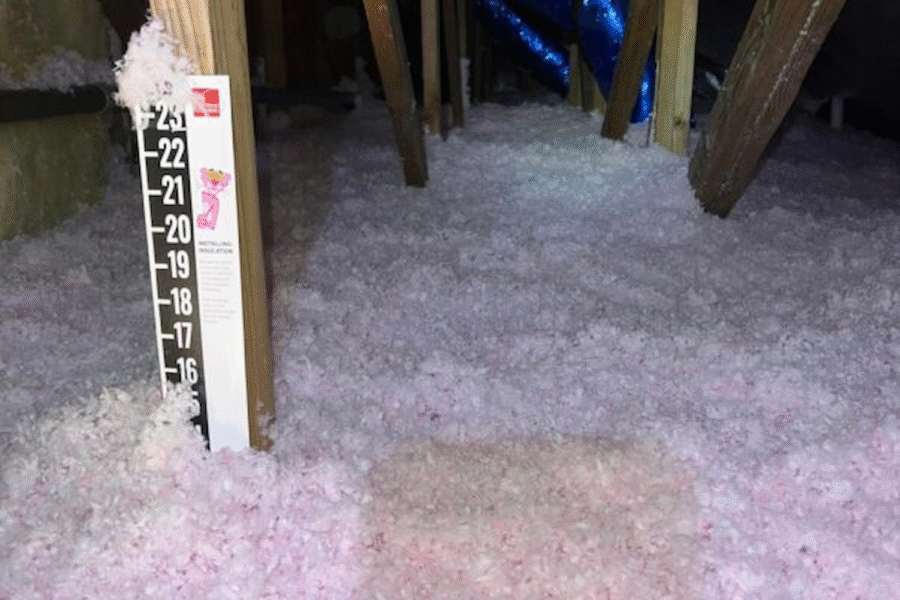
Clean, dry existing insulation may allow additional insulation to be installed over it. Wet, moldy, compressed, pest-soiled, or heavily contaminated material may need removal first.
2. Attic Access
A roomy pull-down stair and open truss layout are easier to work in than a small access hatch, low roof pitch, or attic crowded with mechanical equipment.
3. Air Sealing
Recessed lights, plumbing penetrations, top plates, attic hatches, and open chases can add prep time, but skipping them can undermine performance.
4. Target R-Value
Going from thin existing insulation to a higher target requires more material than a modest top-up.
5. Material Choice
Blown fiberglass and cellulose are generally budget-friendlier; open- and closed-cell spray foam command a premium.
6. Ductwork and Moisture Issues
Damaged ducts, roof leaks, poor ventilation, or moisture concerns may need attention before or alongside insulation work.
7. Removal and Cleanup
On larger or heavily contaminated attics, insulation removal, sanitizing, debris handling, and disposal can add significantly to the project cost.
ENERGY STAR notes that existing insulation usually does not have to be removed when it is dry and free of mold, odor, or animal waste. That is why an inspection matters more than a blanket “replace everything” recommendation.
Choosing the Right Insulation for Your Central Florida Home
For a conventional attic-floor upgrade, blown-in insulation is often one of the first options worth pricing. Fiberglass batts can make sense in open framing or specific accessible areas, while spray foam may be considered when the project involves insulating the roof deck or addressing specific building-envelope goals.
The smartest move is to compare scopes, not just totals.
Ask:
- What material are you using?
- What R-value will I end up with?
- Are you air sealing?
- Is removal included?
- Are ducts being inspected?
- How many square feet are covered?
- What happens if you find moisture or contamination?
Attic Pros serves homeowners throughout Central Florida, including Orlando, Winter Park, and Lake Mary. A local inspection can narrow a broad online price range into an estimate based on your home’s actual attic conditions.
FAQ: Attic Insulation Cost in Central Florida
How much does it cost to insulate an attic in Florida?
A practical 2026 planning range is roughly $1–$7 per square foot installed, depending on material and scope. Blown-in fiberglass, cellulose, and batts generally cost less than spray foam. Removal, air sealing, access, contamination, and R-value targets can raise the total.
How much does it cost to insulate a 1,500-square-foot attic?
Using 2026 Florida market benchmarks, a 1,500-square-foot attic could run roughly $1,500–$3,300 for batts, $1,650–$2,850 for blown fiberglass, $1,950–$3,150 for cellulose, or much more for spray foam. For an exact cost for your attic, request a quote.
Is R-30 or R-38 enough for an attic in Florida?
R-30 and R-38 are common retrofit targets discussed for Central Florida homes, while DOE’s 2021 IECC reference lists R-49 for uninsulated ceilings in Climate Zone 2. The right target depends on the existing assembly, current insulation, and project goals.
Does attic insulation lower electric bills in Florida?
It can. EPA modeling for Climate Zone 2 estimates about 6% total annual utility-bill savings and 9% heating-and-cooling savings from cost-effective air sealing and insulation improvements in a typical existing home. Actual results vary.
Do I need to remove old attic insulation first?
Not always. If existing insulation is dry, clean, and uncontaminated, new insulation can often be added on top. Wet, moldy, pest-soiled, or damaged material may need removal and cleanup first.
Is there a federal tax credit for attic insulation in Central Florida in 2026?
Not under the former Section 25C Energy Efficient Home Improvement Credit. The IRS states that the credit is not allowed for property placed in service after December 31, 2025. Homeowners can still check local utility programs or other current incentives.
Price the Right Fix, Not Just More Insulation
Now you know that attic insulation cost in Central Florida is driven by much more than square footage. Material, R-value, air sealing, access, existing conditions, removal, and the location of your thermal boundary all shape the final number.
So, what should you do next? Ask for an estimate that spells out the material, target R-value, installed depth, square footage, air-sealing scope, and any removal work, then compare apples to apples.
If you’re in Central Florida, Attic Pros can inspect your current insulation and help you determine whether a top-up, removal and replacement, or another insulation approach makes sense for your home. Request a free attic insulation quote and get a project-specific number instead of guessing from a statewide average.